

Mid-year SEO checkup: What’s working, what’s not?

Midway through the year is a good time to see how your SEO is holding up. Search habits shift, rankings change, and AI is reshaping how people find information. A mid-year SEO checkup is all about checking what’s working, what’s not, and what to adjust going forward. Here’s how to get started.
Key takeaways
- Conduct a mid-year SEO checkup to assess your site’s performance and identify areas for improvement.
- Focus on traffic and rankings by analyzing organic trends, keyword movement, and SERP features to spot patterns.
- Perform a content audit to refresh outdated material and adapt to changing user needs and behaviors.
- Emphasize video content and adapt to AI and zero-click searches for better visibility in search results.
- Set clear, specific goals for the remainder of the year to drive actionable improvements and maintain momentum.
Traffic and rankings: What’s changed since January?
Start your mid-year SEO review by checking how your site is performing, not just on the surface level, but deeper down. Look beyond overall traffic and into individual pages and search queries. What’s still working? What’s losing visibility? The goal is to spot slow shifts early, before they turn into bigger problems.
Organic traffic trends
Start with a traffic check in GA4. Compare your organic numbers from January to now, then narrow in on which landing pages have gained or lost ground. After that, use Search Console to see how impressions and clicks line up with the shifts. Look across different devices and locations, because you might notice mobile traffic dropping while desktop traffic stays level.
As you review, think about what’s changed. Are certain types of content sliding? Is the homepage steady while deeper articles get less visibility? Has something in the layout or search results changed how people interact with your site? These patterns will help you figure out where to adjust.
Keyword movement and SERP features
GA4 won’t show you how keywords are doing. For that, use Search Console or Semrush for a more detailed view. It gives you a clearer view of how your top queries are performing and whether their positions are trending up or down. Focus on terms sitting somewhere between positions five and fifteen. These are close to the edge and can shift either way with the smallest change.
Keep an eye out for new queries your site is now appearing for. Also, check whether your content appears in features such as video carousels, People Also Ask, or AI Overviews. These placements affect clicks, even if rankings stay flat.
If CTR is dropping, it might be because the answer’s already visible in the search result. That’s common with broad questions or terms that Google can answer directly with a snippet, a summary, or an AI Overview. Some of these shifts started with recent algorithm updates, so if you saw a change around that time, that might explain it.
Being on page one isn’t always enough now. What matters more is how your page looks and whether it stands out from the rest.
Where’s the gap?
Ranking alone doesn’t mean a page is performing well. Some are still showing up in search but aren’t pulling their weight anymore. Take a look at your top pages from Q1 and compare them to what’s performing now. If something dropped, check for changes. Did the URL structure shift? Was the copy updated? Did anything break during a migration or redesign?
Segmenting traffic helps spot patterns during your mid-year SEO checkup. Blog content might be holding steady while product pages quietly slip, or a location page that used to perform well might now be buried. Sorting traffic this way makes it easier to see where things are improving and where they’ve gone quiet.
Don’t ignore branded versus non-branded search, because if branded terms are down, it may reflect lower awareness. If non-branded terms fell off, that usually points to stronger competition or a shift in search demand. Either way, those are signs to act on, not ignore. Don’t forget to check how your brand performs in AI searches on various LLMs and platforms.
What to do next in your mid-year SEO review
As you review performance, note content that’s lost traffic and look at how it aligns with current keyword trends. Some pages may need updates, while others might be better merged or repurposed. If certain pages are still ranking but getting few clicks, flag those, too, as there may be issues with title tags, metadata, or how the content is framed.
Also, look for signs of new search interest or shifts in consumer behavior that are driving unexpected traffic. Those insights can help guide your Q3 and Q4 planning. A detailed mid-year SEO checkup now helps prevent bigger issues later. Small drops or mismatches in intent can add up over time, especially if you miss the early signs. Use your data to make informed decisions, not just to complete a report.
Audit and refresh your content
Not all content holds its value over time. Some pages stop performing because they’re outdated, while others never performed well to begin with. A mid-year SEO audit helps you figure out what’s worth updating or removing altogether. Focus first on content that’s lost traffic or rankings. Use Google Search Console to find declines in impressions and clicks, then compare that with GA4 engagement metrics. If a page ranks but no longer drives real value, or doesn’t match what users are looking for, it likely needs attention.
Google wants people-first content, not just pages written to rank. If your site relies on thin tutorials, vaguely rewritten definitions, or posts that regurgitate what’s already out there, those pages may be dragging down your overall SEO performance. Commodity content is generic, surface-level posts that don’t add anything new. Today, these no longer stand out in search results, especially with AI-generated overviews and competing articles, so avoid making them. Ask yourself if your post offers a unique perspective, original research, or a fresh angle. If not, it’s time to refresh or remove it.
When updating content, lead with clarity. Remove fluff, update stats, and ensure your answer aligns with the search intent. Don’t just rewrite, but make the page genuinely better by adding depth, examples, or actionable advice that isn’t already everywhere. In some cases, the fix might be cutting it entirely. If a page hasn’t contributed value or activity recently, rethink why it’s there.
Diversify and focus on video
Search results are more visual than they used to be. Video clips now show up in carousels, featured snippets, and AI responses. If your site is still relying on just blog posts, you’re missing opportunities to be seen.
Short videos, especially how-tos, demos, and explainers, can increase visibility on Google, YouTube, and Discover. They also help with engagement, keeping visitors on your site longer.
Start by turning high-performing articles into videos. Post them to YouTube, embed them on your site, and add basic schema markup. Just a few clear, well-structured videos can increase your presence in search results and help reach users who don’t want to read through long text.
Video doesn’t need to be expensive or overly produced. What matters is that it’s useful, focused, and easy to watch. During your mid-year SEO checkup, you might need to improve your video strategy.
Adapting to AI and zero-click searches
More users are getting answers directly on Google, without clicking anything. With AI Overviews and AI Mode becoming more common across search results, especially for question-based queries, your content needs to work even when there’s no obvious incentive to visit your page.
That means clear structure, clean markup, and highly readable content that make it easy for Google to quickly understand the core answer. Place key information prominently on the page and use a strong title, a compelling meta description, and subheadings. Organize your content into scannable sections to increase the likelihood it appears in featured results.
Don’t ignore FAQ or how-to formats, as these can still help Google identify your page’s purpose. Structured data reinforces clarity for both traditional search and AI-generated summaries.
Zero-click doesn’t mean zero opportunity; it can offer great ways to strengthen your brand. Content referenced in AI answers or displayed in SERP features can strengthen brand visibility, build trust, and encourage familiar users to return via other channels later.
What AI Mode means for search visibility
In addition to AI Overviews, Google added a feature called AI Mode. This is a search experience built for more complex, multi-part queries. It pulls information from several sources and delivers a conversational response with helpful links.
Instead of listing links, AI Mode breaks down the query, runs multiple related searches, and returns one detailed answer. There’s less space for traditional rankings, but a chance for useful, well-structured content to be included. If your impressions are rising but clicks aren’t, your content may already appear in these summaries.
AI Mode shows where search is likely headed. And it’s not just Google, as tools like ChatGPT (Search) and Perplexity show that AI-powered discovery is already expanding. As this grows, you might have to rethink how you see content. Learn how to optimize for LLMs using Yoast SEO’s tools and use Yoast AI Brand Insights to see how you perform in Google Gemini, Anthropic Claude, Perplexity, and OpenAI ChatGPT.
Refresh your keyword strategy
Midway through the year is a good time to check if your keyword strategy still aligns with how people are searching. Start with Search Console and any SEO tools you use, and look for shifts in rankings, drops in CTR, or signs that user intent has changed. Some keywords may still rank but deliver less value, while others may be gaining traction.
Take another look at the SERPs. Are AI Overviews, snippets, or video results pushing your links down? If your content no longer fits the query, it may need a rewrite or a new format.
Also consider what’s surfaced since Q1 and see whether seasonal queries or longer questions might now be worth targeting. Even if they bring less volume, they often convert better. Use what you find to adjust your focus for the second half of the year.
Technical SEO clean up
Great content alone isn’t enough if your site’s technical side is holding it back. A mid-year SEO checkup is a good time to inspect the foundation. See how your site loads, how it’s crawled, and whether pages are being properly indexed.
Start with speed, and use Google’s Core Web Vitals tools to review page load performance. Fix common issues like oversized images, unnecessary scripts, or layout shifts that hurt usability. These factors don’t just affect rankings; they also shape how users experience your site, especially on mobile.
Find out how your site is being crawled by search engines and AI platforms. Search Console can show you which pages aren’t being indexed, where crawl issues are occurring, and whether valid content is being skipped. If strong content still isn’t performing, this could be why.
In your mid-year SEO checkup, you should also see your internal linking. Important pages should be easy to reach. If key articles or landing pages are buried under layers of clicks or orphaned entirely, Google’s crawlers and your readers may never find them.
Finally, check your structured data, as schema still gives your content a better chance of being understood by search engines.
A light technical review every few months helps keep things healthy. You don’t need to fix everything at once, but leaving small issues unsolved can turn into long-term performance headaches.
Monitor competitors and trends
Search isn’t static, and neither are your competitors. Even if your strategy hasn’t changed much since Q1, theirs might have. A mid-year SEO checkup is a smart idea to see who’s gaining ground, what kind of content is outperforming yours, and what shifts are happening in your space as a whole.
Start by checking who’s around you in the search results, especially for your highest-value keywords. Are the same domains showing up? Has a competitor overtaken you with fresher content, a better format, or a new angle? Sometimes it’s less about Google’s algorithm and more about someone else simply doing it better.
Use ranking and backlink tools to identify newer content that’s climbing the rankings. What’s different? Is it shorter, clearer, or more visual? Has it earned links or been widely shared? These observations can shape not just what you publish next, but how you structure and present it.
Whether you’re in an aggressive or stable position, awareness is part of strategy. Without reviewing what others are doing, you don’t have a clear view of what winning looks like right now or how quickly that picture is changing.
Set clear goals for the rest of the year
After reviewing performance, updating content, resolving technical issues, and refreshing keywords, the next step in your mid-year SEO checkup is to set focused goals for the rest of the year.
Be sure to keep your goals specific, because goals like “get more traffic” are too vague to drive clear action. Use what you’ve learned, whether that’s from rankings, audit results, or crawl reports, to define outcomes that are tied to your time, resources, and business needs.
Look for low-effort wins and long-term improvements. Fix pages that rank but don’t get clicks, and update content that dropped after an algorithm change. Strengthen internal links to help strong posts on the edge of page one move up. These small changes can improve results with less time than it takes to start from scratch.
If AI features are reducing your traffic on top queries, consider focusing more on visibility than clicks. That might mean leaning into content formats that stand out in summaries, like FAQs or short-form video.
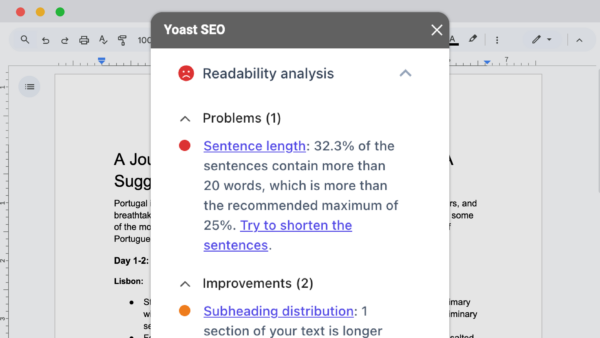
You can also set process goals: publish more consistently (maybe using workflow improvements from Yoast SEO’s Google Docs add-on), clean up old content, reduce crawl waste, or make reporting easier. These are just as important as traffic-focused targets, and they’re often easier to maintain over time.
Your goals don’t need to be dramatic. Often, refining what already exists yields greater gains than pursuing something new. Revisit your targets regularly and track your progress without overthinking it. Most importantly, stay flexible heading into Q4, when search activity and competition both tend to spike.
Do your mid-year SEO checkup
Search has changed a lot since January, and it’s not slowing down. A mid-year SEO strategy review gives you the chance to course-correct, refocus your efforts, and keep momentum going into the back half of the year.
You don’t need to overhaul everything. Just fix what’s broken and make better decisions with what you know now. Stay consistent and keep building.
